Coliving Language Immersion for Digital Nomads in 2026: How to Choose a Shared House That Actually Makes You Speak
Coliving Language Immersion for Digital Nomads in 2026: How to Choose a Shared House That Actually Makes You Speak
If coliving language immersion for digital nomads sounds like one of those phrases invented by a growth marketer in a linen shirt, fair. But the underlying idea is solid as hell. Where you live shapes who you meet, what language you hear, how often you repeat useful conversations, and whether your “immersion” is real or just a laptop colony with better coffee. For nomads who actually want to learn the local language, housing is not just logistics. It is one of the biggest levers in the whole system.
That is why coliving language immersion for digital nomads matters so much in 2026. A lot of remote workers have finally figured out that language progress does not come from hopping cities, collecting cafés, and pretending one meetup a week counts as local life. It comes from repeated contact in places where people cook, complain, joke, coordinate plans, ask for help, and keep using the same language around you until you either join in or stay the weird silent furniture.
We have already covered slow travel language learning, the digital nomad language routine, local events for language learning while traveling, and the language exchange club system. Coliving language immersion for digital nomads is what happens when you move the same logic into the place you come home to every night.
What Coliving Language Immersion for Digital Nomads Actually Means
Let’s kill one dumb idea immediately. A house full of foreigners with one local cleaning staff member is not immersion. That is just rent with branding.
Real coliving language immersion for digital nomads means your housing setup creates repeated, low-friction contact with local language in ordinary life. That can happen through:
- a coliving house with local residents or hosts
- a family homestay with enough adult autonomy to keep your sanity
- a shared apartment with mostly local roommates
- a neighborhood guesthouse where repeat social contact is normal
The common thread is not the label. It is the pattern:
- you hear the language often
- you hear it in routine situations
- the same people appear again
- you get chances to speak without booking special events every damn time
That is what makes housing part of your language engine instead of just the place where you recharge your laptop and doomscroll.
Why Coliving Language Immersion for Digital Nomads Beats Generic Housing
A solo apartment can be great for focus. A random expat-heavy coliving can be great for networking. But coliving language immersion for digital nomads wins when your goal is repeated real-world language contact.
Why? Because daily life keeps handing you tiny speaking reps:
- kitchen questions
- grocery coordination
- house jokes
- schedule changes
- noise complaints
- borrowed salt diplomacy
- “are you coming tonight?” type conversations
None of those interactions are dramatic. Good. That is exactly why they work.
The strongest language environments are not always intense. They are recurring.
Research summaries from NAFSA keep pointing toward the same broad lesson: immersion quality matters, not just travel prestige. More specific work on residence type backs that up. Studies like Dining on Language and Culture, Contextual Factors in Second Language Learning in a Short-Term Study Abroad Programme in Australia, and Study Abroad in Turkey: the Role of Homestays on Second Language Learning all point toward the same basic truth: residence environments can create or block language opportunities.
Coliving Language Immersion for Digital Nomads Works Best in the Kitchen, Not the Classroom
This is the part people underestimate.
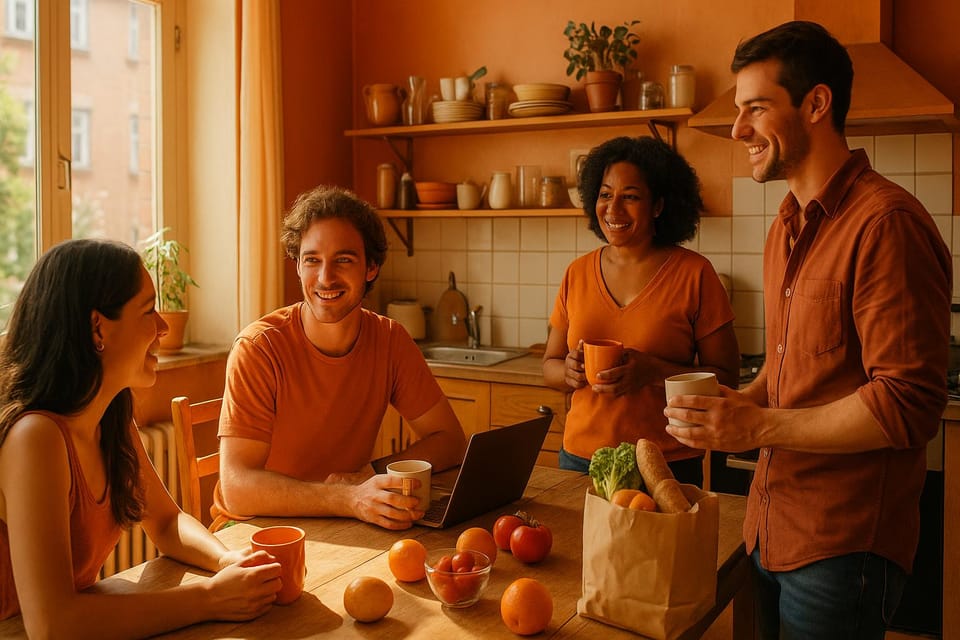
The best coliving language immersion for digital nomads does not come from formal “language hours” posted on a fridge like some miserable corporate retreat. It comes from repeated, semi-messy domestic life.
Shared meals matter more than inspirational wall art
A house dinner does more for language than a motivational slogan about community ever will.
Meals generate:
- recurring vocabulary
- stories about the day
- clarifying questions
- teasing and humor
- culturally specific routines
- natural turn-taking
That is why the mealtime angle in the homestay literature matters. People learn a lot at the table because language there is functional, repeated, and social.
Weak ties are gold
You do not need instant best friends. You need recurring humans.
The roommate who asks what you are cooking. The host who explains how the laundry system works. The neighbor who joins the courtyard chat every other evening. Those weak ties create the repetitions that textbooks and one-off meetups cannot.
Domestic language is honest language
At home, people are less polished. They speak faster, cut corners, use filler, interrupt, joke, and refer to shared context. It is less clean than a class and more useful than most classes.
That is also why coliving language immersion for digital nomads can feel harder than your app-based routine. Good. Harder usually means more alive.
How to Choose Coliving Language Immersion for Digital Nomads Without Getting Trapped in an English Bubble
The marketing copy will lie to you. Assume that upfront.
A listing that says “international community” usually means English-first. A listing that says “perfect for networking” often means nobody is there to speak the local language with you. A listing that promises “cultural exchange” may still be 90 percent transient foreigners who all default to English because it is easier.
So ask better questions.
Ask who actually lives there
Not “is it social?”
Ask:
- how many long-term local residents are in the house?
- what language do people usually use at dinner?
- are hosts or managers local and present, or just remote operators?
- do people share meals or mostly vanish into their rooms?
- how long do residents typically stay?
You are not buying vibes. You are buying repetition density.
Ask what the house routine looks like
The best setups have recurring points of contact:
- shared breakfast or dinner nights
- weekly cleaning or shopping coordination
- group walks, classes, or neighborhood rituals
- one or two common areas people actually use
Dead social architecture kills immersion. If the space is designed so everyone can hide efficiently, guess what they will do.
Check the neighborhood, not just the building
A great house in a sealed tourist district still limits your language growth. The best coliving language immersion for digital nomads happens when your housing and your block work together.
You want:
- local businesses you can revisit daily
- walkability
- one or two recurring events nearby
- enough non-tourist life that English is not the default setting
That fits exactly with what we said in slow travel language learning. Neighborhood repetition beats city-hopping every time.
A 30-Day Coliving Language Immersion for Digital Nomads Plan
You do not need to become the house mascot on day one. Relax.
Days 1 to 5: map the social rhythm
Figure out:
- who is around regularly
- when people gather naturally
- which interactions stay in the local language
- where English takes over and why
Do more listening than performing.
Days 6 to 10: start with functional house language
Own the phrases you will actually use:
- Is anyone using the kitchen?
- I am heading to the market.
- Do we need anything for the house?
- What time are people eating?
- Can you show me how this works?
This is the part where a lot of nomads overreach. They want slang and banter before they can navigate sponge logistics. Back it up.
Days 11 to 18: join repeated house rituals
Pick one or two things you can keep showing up for:
- dinner
- coffee
- grocery run
- language exchange night
- gym or walking plan
This stacks beautifully with the digital nomad language routine because the housing itself becomes part of the routine instead of competing with it.
Days 19 to 24: widen from house to neighborhood
Now connect the house to the area:
- invite one roommate to a local café
- join a nearby class together
- attend a recurring event
- use the same bakery, market, or park often enough to be recognized
This is where local events for language learning while traveling stop being isolated outings and start feeling like extensions of home life.
Days 25 to 30: test whether the setup is actually immersive
Ask yourself:
- am I hearing the local language every day?
- do I speak more here than I did in solo housing?
- do conversations repeat with the same people?
- do I know more useful everyday phrases than I did three weeks ago?
- am I still defaulting to English because the house makes it too easy?
If the answer to the last one is yes, the problem may not be you. The house may just be a dressed-up expat tank.
Red Flags That Coliving Language Immersion for Digital Nomads Is Fake
Watch for these.
Everyone is passing through too fast
If the entire house rotates every four days, relationships never settle long enough to create language momentum.
Social life is event-heavy but routine-light
If everything depends on organized outings and nothing happens naturally in the house, immersion stays performative.
The house staff speaks English by design
Convenient? Sure. Helpful for language growth? Not always.
You spend all day working in English and all night socializing in English
At that point the “local immersion” line in the listing is just cosplay.
The house is far better at content creation than conversation
If the main product seems to be rooftop photos, co-branded yoga, and smiling strangers holding coconuts, maybe do not expect deep linguistic transformation.
When Coliving Language Immersion for Digital Nomads Is Worse Than a Solo Apartment
Here is the honest part.
Sometimes coliving language immersion for digital nomads is a worse choice than living alone.
A solo apartment can beat a bad coliving if:
- the house language is overwhelmingly English
- the social energy is chaotic and exhausting
- you cannot focus enough to keep your work and language routine stable
- the house is full of tourists, not residents
- you already built a strong local routine outside the home
This is not religion. It is systems design.
Sometimes the better move is a quiet apartment in a local neighborhood plus a strong outside routine:
- same coffee shop
- same gym
- same language exchange
- same market
- same weekly event
That can still create immersion if the environment around you is sticky enough. But when the housing itself helps, it helps a lot.
Final Take on Coliving Language Immersion for Digital Nomads
Coliving language immersion for digital nomads works when your housing produces repeated, low-drama, real-life contact with the local language. Not once a week. Not through branding. Daily.
The winning setup is not necessarily the coolest one. It is the one where ordinary life keeps pulling you into small conversations until speaking stops feeling like a separate project.
So before you book your next place, ask the only question that really matters: will this house make it easier to hide in English, or harder?