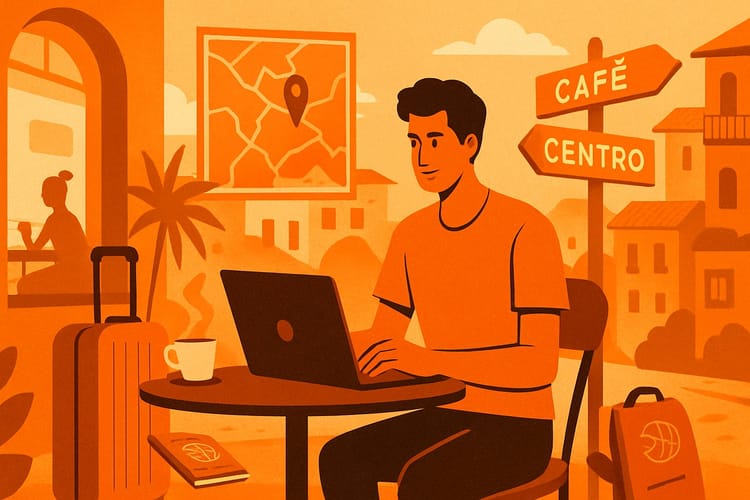
How to Learn a Language While Traveling and Working Remotely in 2026: A Digital Nomad System That Actually Survives Real Life

How to Learn a Language While Traveling and Working Remotely in 2026: A Digital Nomad System That Actually Survives Real Life
If you are trying to learn a language while traveling and working remotely, you already know the fantasy version is bullshit. The fantasy says you land in a new country, order two coffees, smile bravely at a market vendor, and somehow become conversational between Zoom calls. Real life is messier. Client work runs long. You pick housing based on Wi-Fi instead of immersion. You meet other nomads who speak flawless airport English. And three weeks later you realize you have traveled a lot without actually speaking much.
That is why learning how to learn a language while traveling and working remotely needs a system built for unstable schedules, social fatigue, and the fact that your workday can blow up with no warning. The goal is not to imitate a full-time study abroad program. The goal is to weave the language into a nomad life that already exists. That is where this fits with our recent pieces on slow travel language learning, the digital nomad language routine, a language-learning neighborhood walk, and homestay immersion for digital nomads. Same core idea every time: repetition beats tourism.
Why learning a language while traveling and working remotely is harder than it looks
Travel gives you novelty. Novelty is not the same thing as repetition. And repetition is what language growth actually needs.
When people fail to learn a language while traveling and working remotely, it is usually because of one of these traps:
- they move too often for local relationships to form
- they choose convenience neighborhoods where English does all the work
- they burn all their social energy on remote work, then hide at night
- they treat language as an optional side quest instead of part of daily logistics
- they keep chasing “immersive experiences” instead of building recurring routines
Remote work makes this worse because the laptop eats the middle of the day. A lot of nomads end up with one work identity and one travel identity, but no local identity at all. That is how you spend a month somewhere and still feel like you never really arrived.
Reports from MBO Partners keep showing how large the digital nomad population has become, and global travel data from UN Tourism makes the same point in a different way: more people are mobile than ever. But mobility alone does not create immersion. In fact, it can quietly destroy it if your life never repeats long enough for the language to stick.
The best way to learn a language while traveling and working remotely
The cleanest answer is this: build language into the parts of your week that already happen, not the parts you hope will happen.
That means attaching language reps to:
- morning coffee or breakfast
- commuting or walking routes
- lunch errands
- one recurring evening activity
- housing choices and neighborhood anchors
- one weekly social ritual
You do not need ten systems. You need one system that survives bad weeks.
A 5-part framework to learn a language while traveling and working remotely
1. Pick a city where daily life actually pressures you to speak
A pretty city is not enough. Cheap rent is not enough. A cool café scene is definitely not enough.
If you want to learn a language while traveling and working remotely, your base should make speaking useful. Ask:
- Will I hear the local language constantly?
- Can I walk to groceries, cafés, gyms, and services where locals actually go?
- Is the city socially navigable without defaulting to English every time?
- Can I afford to stay long enough for routines to form?
This is why slow travel language learning keeps beating city-hopping. One month in a useful neighborhood crushes four countries in a blur.
2. Build one neighborhood loop
Forget conquering the whole city. That is tourist brain.
Choose one neighborhood and make it your language lab:
- one morning coffee place
- one grocery store or market
- one work-friendly spot
- one evening place with recurring humans
That loop matters because people start recognizing you. Once your face is familiar, the conversation changes. It gets less transactional and more natural. That is the invisible upgrade most nomads miss.
If you want a dead-simple version of this, use the neighborhood walk system. It sounds almost too simple, which is exactly why it works.
3. Protect small daily reps instead of waiting for huge immersive days
Massive “immersion days” are cute on Instagram and unreliable in real life. Small reps travel better.
Good daily reps include:
- ordering and chatting for one minute every morning
- asking one real question during an errand
- reading signs, menus, and notices out loud or silently as you walk
- listening to a short local news clip before work
- sending one text in the target language to a tutor, friend, or exchange partner
The win is frequency. Not elegance. Not some cinematic breakthrough at sunset.
4. Use remote work as a language tool, not just a language obstacle
This is where a lot of people miss the plot.
Your work life already gives you systems, repetition, and communication goals. Use that. If you want to learn a language while traveling and working remotely, treat your job as structure.
Examples:
- Write your daily plan in the target language first, then translate the missing pieces later.
- Label work objects and software habits with local vocabulary.
- Rehearse short self-intros for cafés, coworking spaces, and social events.
- Practice explaining your work simply, because locals always ask what you do.
- Turn lunch breaks into neighborhood-language errands instead of delivery-app hibernation.
This is also why a realistic digital nomad language routine matters more than some fantasy three-hour study block.
5. Build one recurring local social ritual
This is the piece that separates “I visited” from “I lived here.”
Find one thing you can attend weekly:
- a language exchange you actually like
- a dance class
- a climbing gym
- a running club
- a trivia night
- a volunteer shift
- a neighborhood event
The exact ritual matters less than the recurrence. Local events for language learning work because they create repeated low-stakes contact. A single big night out does not.
A weekly schedule to learn a language while traveling and working remotely
Here is a version that works even if your work is annoying.
Monday: map the week
- Choose three tiny speaking goals.
- Pick your anchor locations.
- Preload 10 to 15 phrases you are likely to need.
Tuesday: morning and lunch reps
- Order or buy something in the target language.
- Ask one follow-up question.
- Do one short listening rep before work.
Wednesday: neighborhood repetition
- Return to the same café or market.
- Reuse yesterday’s phrase.
- Notice one local expression you keep hearing.
Thursday: remote-work integration
- Journal about your workday in the target language.
- Practice explaining your project simply.
- Do one AI or tutor speaking rep after work if your brain still functions.
Friday: social extension
- Attend your recurring event.
- Introduce yourself the same way each week.
- Stay ten minutes longer than you normally would.
Weekend: reset and expand
- Walk the neighborhood without headphones.
- Go to a market, park, bookstore, or event where the local language is doing real work.
- Review the phrases that showed up naturally.
That is enough to compound. Not instantly. But steadily, which is the whole point.
Housing choices that make or break language growth
If you are serious about learning while working remotely, housing is not just a money decision. It is a language decision.
Best housing setups for language learning
- homestays with stable routines
- local apartment neighborhoods, not tourist party zones
- coliving spaces with actual local participation
- smaller guesthouses where staff recognize you
Weak housing setups for language learning
- luxury nomad compounds where nobody needs the local language
- isolated Airbnbs that turn you into a delivery-app goblin
- ultra-short stays that reset your social graph every ten days
This is why homestay immersion and even carefully chosen coliving can punch above their weight.
Common mistakes when trying to learn a language while traveling and working remotely
Moving too fast
Every relocation wipes out momentum. New routes, new shops, new accents, new logistics. Slow down.
Hiding inside work
Some days you are genuinely cooked. Fine. But if every day becomes work-then-screen-then-bed, the city never gets a chance to teach you anything.
Over-planning and under-repeating
A giant Notion board full of phrase lists is not immersion. A familiar barista and a reused question are.
Confusing English-friendly with life-friendly
Convenience has a cost. If the environment removes all pressure to speak, your speaking will stay soft.
Waiting for confidence
Confidence is usually a side effect of repeated low-stakes contact. It is not a prerequisite.
External resources worth using
If you want outside reading that is actually useful, start here:
Use them for context. Your real teacher is still the repeated life you build on the ground.
Final take
If you want to learn a language while traveling and working remotely, stop waiting for some magical immersive week where everything lines up perfectly. Build a city life that repeats. Pick the right neighborhood. Protect tiny daily reps. Use your work routines instead of fighting them. Then add one recurring social ritual that keeps putting you in the path of the same humans.
That is not glamorous. It is better. It is how a place stops feeling like a backdrop and starts becoming a real life.
So what is one repeating part of your current city routine that could become a language rep by tomorrow instead of staying another forgettable expat convenience?