
Language Learning Neighborhood Walk for Digital Nomads: The Daily Routine That Turns Any City Into a Classroom
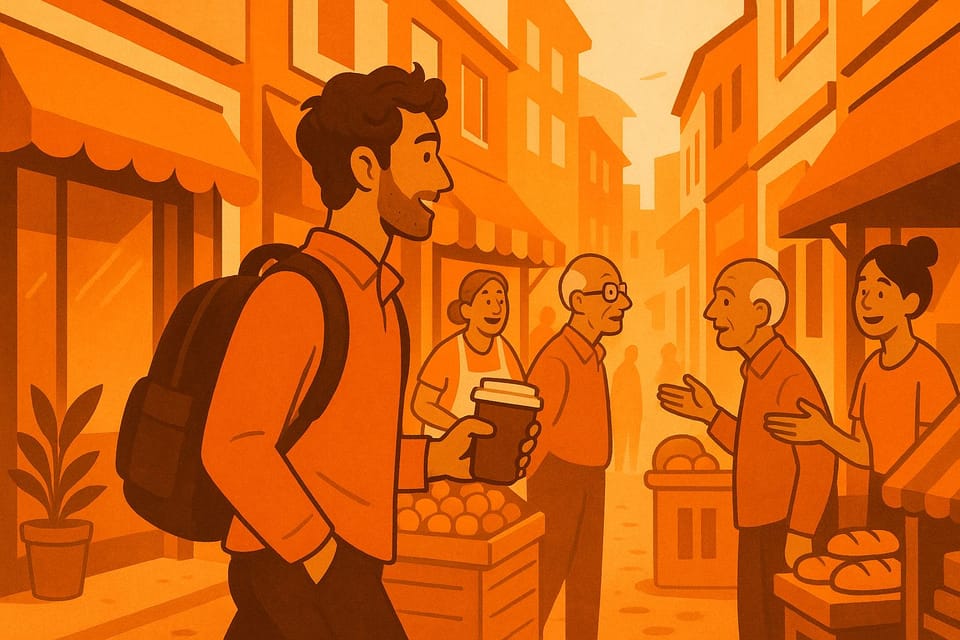
A language learning neighborhood walk for digital nomads sounds almost too simple, which is probably why more people do not use it. They move to a new city, talk big about immersion, then spend most of the week inside one coworking space, one WhatsApp group, and one overpriced brunch spot full of other remote workers. That is not immersion. That is tourism with a laptop.
If you want your local language to improve while traveling, you need repeated contact with the same streets, the same shopkeepers, the same signs, the same little social risks. A neighborhood walk gives you exactly that. It turns your daily movement into a language-learning system instead of random exposure.
For digital nomads, this matters because the usual advice is too vague. “Talk to locals” is not a system. “Immerse yourself” is not a plan. A language learning neighborhood walk for digital nomads is a plan you can actually repeat.
Why a neighborhood walk works better than fake immersion
Most travelers confuse presence with exposure. Just because you are physically in Mexico City, Lisbon, or Taipei does not mean your brain is getting useful language reps.
Useful reps come from:
- repeated contact with familiar places
- predictable interactions you can improve over time
- visual cues tied to real words
- small conversations with low social stakes
That is why neighborhood-based immersion works so well. You stop skimming the surface and start building recognition. The fruit stand is not just “some local place” anymore. It becomes where you practiced asking for half a kilo, heard casual filler words, learned how people soften requests, and noticed which phrases actually get used.
This is also why neighborhood language immersion for digital nomads was such a strong topic for the site. It matches how real progress happens on the road, through repeated context, not one heroic night at a meetup.
What a language learning neighborhood walk for digital nomads actually is
It is not a sightseeing walk.
It is a 25 to 45 minute loop you repeat several times a week in the same part of town, with a language target for each pass.
Your route should include places like:
- a cafe or bakery
- a grocery store or market stall
- a pharmacy or convenience store
- a park, square, or dog-walking route
- a kiosk, bookstore, or transit stop
The point is not mileage. The point is density of useful repetition.
The best daily structure
Here is the routine I would use if I landed in a new city tomorrow.
Pass 1: Notice the visible language
Look for:
- store signs
- menu phrases
- handwritten notices
- opening-hour boards
- transit instructions
- product labels
Take quick notes on phrases you keep seeing. Those are usually high-frequency words tied to real life, which means they are worth learning before some textbook nonsense about ancient castle tours.
Pass 2: Trigger one low-stakes interaction
Buy one thing. Ask one question. Clarify one detail.
Examples:
- Do you have this in a smaller size?
- Is this spicy?
- What time do you close?
- Can I pay by card?
- Which one do people usually order?
If you repeat this across the week, your speaking confidence compounds fast.
Pass 3: Retell the walk out loud afterward
When you get home, summarize what happened in the target language for two minutes.
Describe:
- where you went
- what you saw
- what you bought
- what someone said
- what you could not understand
That quick retelling connects recognition to recall, which is where a lot of nomads drop the ball.
Why digital nomads especially need this
Remote workers have a weird problem. They often have location freedom without local integration.
The default digital nomad setup encourages isolation:
- work alone
- order food in English
- hang out with international people
- move neighborhoods too quickly
- rely on translation tools to remove friction
That setup makes life easier, but it slows language growth to a crawl.
A language learning neighborhood walk for digital nomads fights that by creating a small zone of recurring friction. Not overwhelming friction, just enough to force attention.
This complements other local-language strategies like how digital nomads learn local slang in 2026 and coworking spaces as language-learning hubs. But the walk is better because it is yours, daily, and not dependent on event schedules or social energy.
What to focus on during week one
Your first week should be about survival language and pattern recognition.
Learn the phrases that unlock tiny conversations
Focus on:
- greetings and polite openers
- payment and quantity questions
- location and direction questions
- clarification phrases like “can you repeat that?”
- simple opinion phrases like “I am just looking” or “this is great”
Collect local filler words
Every place has tiny verbal habits that make you sound less stiff. These are the words people use to soften requests, signal agreement, or buy time.
You do not need many. You just need the common ones that show up every day.
Notice rhythm and body language
Language is not only words. Watch how people pause, point, nod, and soften direct requests. That is part of fluency too.
How to turn the walk into a real learning loop
A lot of people walk, notice things, and then never convert that into memory. Waste of a good opportunity.
Use this loop instead:
- walk and collect 5 to 8 useful phrases
- review them that evening
- reuse 2 or 3 on your next walk
- record a short summary afterward
- test them again in a new interaction
That is how random exposure becomes active learning.
This method also plays nicely with the systems in language exchange meetups for digital nomads because the walk gives you real phrases to bring into longer conversations.
What the broader evidence suggests
Even when research is not framed specifically around digital nomads, social integration and repeated context show up again and again as key ingredients in language development.
The practical takeaway is obvious: people learn faster when language is tied to recurring environments, real interactions, and meaningful participation in everyday life.
Useful reads on that broader idea include work on language, learning, and social integration, along with studies on digital literacy and integration support in adult language learning contexts.
- Cambridge: Progression in Language, Learning and Social Integration
- De Gruyter: LINCing learners to digital literacy, supporting social integration and English language learning during COVID-19
- Emerald: The Digital Nomad
And for travel behavior that shapes integration, official resources are also useful:
- UN Tourism
- OECD tourism and local development resources
- European Commission language and mobility resources
A 30-day neighborhood walk challenge
If you want structure, here it is.
Week 1: map the route
Pick one neighborhood and repeat the same loop three to five times.
Week 2: add conversation triggers
Plan one purchase, one question, and one follow-up per walk.
Week 3: expand your territory carefully
Add one nearby street or business type, but keep most of the route the same.
Week 4: deepen relationships
Aim to become a familiar face at two or three places. Recognition changes everything. People speak more naturally once you are not just another passerby.
How to adapt the walk for different nomad styles
A good language learning neighborhood walk for digital nomads is not one-size-fits-all. Your route should match the way you actually live.
If you are a deep-stay nomad
Stay obsessed with consistency. Pick the same blocks, same cafe window, same market lane, same park bench area. Familiarity turns strangers into recurring characters, and recurring characters turn language into something social instead of abstract.
If you move every few weeks
Keep the structure the same even when the city changes. Use the same categories everywhere:
- one coffee stop
n- one practical errand - one observation point
- one question you ask repeatedly
That way your routine transfers even when your geography does not.
If you are shy
Use a two-tier version. First week, focus on signs, menus, and tiny transactions. Second week, add one extra sentence to every interaction. You do not need charisma. You need reps.
If you already speak at an intermediate level
Push beyond transactions. Ask local preference questions, request explanations, or make short comments that invite a response. This is where a neighborhood starts giving you real conversational texture instead of memorized service language.
Why this beats binge learning on weekends
A lot of remote workers try to compensate for low daily contact with big heroic efforts on Saturdays. They book a tutor, hit a meetup, and spend three hours trying to become a local. Then they disappear back into English for six days.
That approach feels intense, but it is weaker than steady neighborhood contact.
A daily or near-daily walk works better because it gives you:
- spaced repetition in the wild
- immediate relevance
- low-pressure contact with the same phrases
- more opportunities for recognition by locals
The same logic shows up in good learning systems everywhere. Small repeated contact wins. That is part of why learning the local language in your first week abroad works best when it is tied to ordinary routines, not fantasy immersion marathons.
Mistakes that ruin the method
Moving around too much
If you change neighborhoods every day, you kill repetition.
Hiding behind headphones
Music turns your walk into private time. Fine for exercise, terrible for immersion.
Taking notes like a maniac mid-conversation
Do not make it weird. Be present. Jot things down after.
Measuring success by long conversations
Short, repeatable interactions beat one dramatic breakthrough.
Final take
A language learning neighborhood walk for digital nomads works because it turns daily movement into repeated contact, repeated contact into memory, and memory into usable speech. It is simple, cheap, sustainable, and a hell of a lot more effective than pretending your apartment and coworking pass count as immersion.
Pick a route, repeat it, talk a little more each week, and let the city teach you through familiarity instead of fantasy.
If you had to choose one neighborhood in your current or next city to become your language-learning zone, where would it be, and what kind of daily interaction would you build around it first?