
The Digital Nomad's Language Learning Stack: Combining AI Tools and Human Practice for Real Fluency in 2026
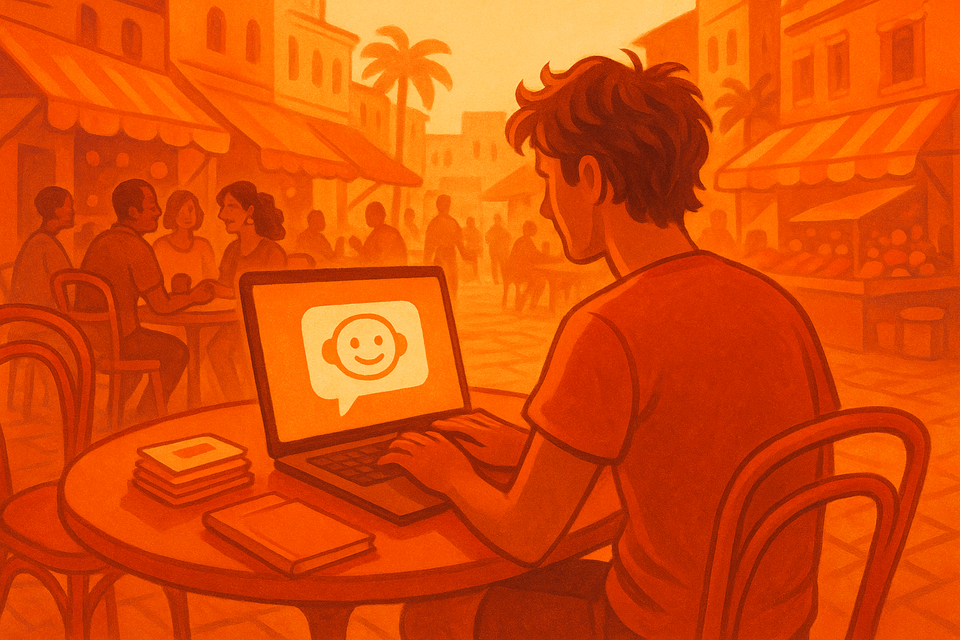
Ask a hundred digital nomads how they learn languages and you will get a hundred different answers. Some swear by Duolingo streaks. Others pay for weekly tutoring sessions that keep getting rescheduled when flights change. A few simply hope that living in a place will somehow make the language stick. The problem with all of these approaches? They treat language learning as a single activity rather than what it actually is: a system. The most effective nomads in 2026 are building what linguists and productivity nerds alike are now calling a digital nomad language learning stack, a layered combination of AI conversation tools, structured input, and deliberate human practice that adapts to the chaos of nomadic life.
This post breaks down exactly how that stack works, what goes into each layer, and how to sequence your learning so that every hour you invest compounds into real, usable fluency, no matter which time zone you wake up in.
Why Single-Tool Language Learning Fails Digital Nomads
Language learning apps are built for people with stable lives. A consistent commute, a fixed city, a reliable wifi connection, and the same daily routine. Digital nomads have almost none of these things. When you are context-switching between cities every four to eight weeks, the app-first approach collapses for a few predictable reasons:
- Motivation tied to location. You picked up Thai when you were in Chiang Mai, but now you are in Lisbon and suddenly the urgency is gone. Your streak dies in a week.
- No accountability structure. Without a teacher, a class, or a speaking partner who expects you at a certain time, language study is always the first thing to get bumped by a client deadline.
- Single-skill development. Most apps train reading and listening recognition. They do very little for your ability to hold a spontaneous conversation, which is ultimately what you need when you land somewhere new.
- Language guilt accumulation. Every day you skip practice, the gap between your app and your actual spoken ability widens, and the shame spiral makes it harder to return.
The solution is not to find the perfect app. It is to build a stack where each layer compensates for the weaknesses of the others, and where no single missed session derails your progress.
The Four Layers of the Digital Nomad Language Learning Stack
Think of your language learning stack the same way a developer thinks about a technology stack. Each layer has a specific job. Remove one and the whole system gets slower and less reliable. Here is how to build it.
Layer 1: AI Conversation Practice (The Foundation)
This is the layer that has transformed language learning more than anything else in the past two years. Large language models like ChatGPT, Claude, and purpose-built tools like Praktika or Langotalk now allow you to have realistic, corrective conversations in almost any language at any hour. For nomads, this is revolutionary: no scheduling, no timezone juggling, no cancellations.
A 2025 systematic review published in ScienceDirect found that AI-powered chatbots positively impact speaking ability, self-confidence, and grammar accuracy in second language learners, particularly when learners receive real-time corrective feedback. That is precisely what modern AI tools can deliver at scale.
How to use AI conversation practice in your stack:
- Start each morning with a 10 to 15 minute AI conversation in your target language. Treat it like a warm-up.
- Set a persona. Ask the AI to act as a local shopkeeper, a landlord, a coworker. Scenario-based practice mimics the conversations you will actually have that day.
- Request corrections at the end, not during. Interruptions break the flow. Ask for a summary of your mistakes after each session.
- Use AI to build a vocabulary cheat sheet for wherever you are. "Give me 20 phrases I will need at a Vietnamese street market" is an instruction any LLM handles beautifully.
A broader meta-analysis of 30 empirical studies on AI chatbots in L2 education confirms significant gains across speaking, writing, reading, grammar, and vocabulary when AI tools are used as a structured supplement rather than a replacement for real human interaction. That distinction matters enormously for how you build your stack.
Layer 2: Comprehensible Input (The Fuel)
Linguist Stephen Krashen's input hypothesis has been around since the 1980s, but it has aged remarkably well. The core idea: you acquire language most naturally by being exposed to content that is just slightly above your current level, comprehensible enough to follow but challenging enough to push you forward. For nomads, this layer is the easiest to maintain because it requires almost no willpower.
You are already consuming content during your day. The goal is to redirect as much of it as possible into your target language:
- Podcasts: "Coffee Break Spanish," "InnerFrench," "Portugues Naturalmente" and dozens of similar shows are specifically designed for intermediate learners. Plug them in during your walk to the coworking space.
- YouTube channels in target language: Find creators who talk about topics you already enjoy. Cooking, travel, finance, tech. The content hooks you; the language does its work in the background.
- Netflix with dual subtitles: The Language Reactor browser extension lets you watch shows with subtitles in both your native language and your target language simultaneously. Thirty minutes of evening TV becomes thirty minutes of immersive input.
- Local radio and news: When you arrive in a new city, find a local radio station or news site. Listening even when you do not fully understand builds your ear for natural speech rhythm and pronunciation.
This layer requires almost no scheduled time. You are doing it instead of other passive consumption, not in addition to it. That is what makes it sustainable across every timezone change and city hop.
Layer 3: Spaced Repetition Vocabulary (The Structure)
Vocabulary is the bottleneck for most intermediate learners. You understand grammar. You can follow conversations at half-speed. But the moment a conversation moves fast and uses words you have not drilled, you lose the thread. Spaced repetition systems (SRS) like Anki solve this by showing you words at precisely the interval before you would forget them.
A 2025 systematic review in Springer's Discover Computing journal examined AI in second language acquisition across a decade of research and found that adaptive, spaced learning consistently outperforms massed practice for vocabulary retention. The best SRS tools now integrate AI to generate example sentences, audio, and context-rich cards automatically.
For nomads specifically:
- Keep your Anki deck under 20 new cards per day. Consistency over volume.
- Build decks around real situations you are experiencing. Apartment hunting vocabulary when you are looking for a place to stay. Restaurant vocabulary when you are eating out three times a day.
- Use your AI layer to generate cards from conversations. If the AI corrects a word you used wrong, turn that word into an Anki card immediately.
Fifteen minutes of Anki per day, done consistently for six months, will expand your active vocabulary faster than hours of passive app-based learning.
Layer 4: Human Exchange and Real-World Practice (The Proof)
This is the layer that makes everything else real. AI conversations are valuable, but they will not give you the adrenaline of speaking to an actual person who has no obligation to be patient with you. Human interaction is where your language moves from your head into the world, and where fluency actually develops.
For nomads, this layer looks different depending on how long you stay in a place. Our guide on the slow travel 1-3 month immersion method goes deep on how to maximise this when you have time in one location. But even on shorter stays, you can build meaningful human practice into your routine:
- Language exchange apps: Tandem, HelloTalk, and Speaky let you match with native speakers who want to learn your language. You practice their language for 30 minutes; they practice yours for 30 minutes. It is free, flexible, and surprisingly effective for building conversational confidence.
- Local meetups: Internations, Meetup.com, and Facebook expat groups in most major nomad cities host weekly language exchange nights. The social atmosphere makes the practice feel less like studying and more like making friends.
- Intentional daily interactions: Order your coffee in the local language. Ask directions even when you know the way. Chat with your landlord about the neighbourhood. These micro-interactions compound. By the end of a month-long stay, they add up to hours of real conversation practice.
- Coworking connections: Local coworking space members are often an underused resource. Many nomad-friendly coworks attract both locals and international workers. As we explored in our post on how coworking spaces became the secret weapon for language learning nomads, these spaces can be your most reliable gateway to native speaker conversations.
Research from a study published on PubMed Central found that AI-based language instruction significantly improved speaking skills and self-regulation, but noted that learners who combined AI practice with real human interaction outperformed those who used either alone. The stack approach is not just more convenient; it is more scientifically sound.
How to Sequence Your Stack Through the Day
Knowing what layers to build is one thing. Knowing when to use each one is what makes the system actually work in a nomadic lifestyle. Here is a sample daily rhythm that adapts to almost any schedule:
- Morning (15 min): AI conversation warm-up. Talk about your plans for the day in your target language. Ask for corrections at the end. Update your Anki deck with any new vocabulary that came up.
- Commute or walking (20-40 min): Comprehensible input. Podcast or YouTube video at your level. No need to take notes. Passive immersion does its work without you having to think about it.
- Anki (10-15 min): Do your daily review before or after lunch, when your brain is in a stable, alert state. Avoid doing it right before bed when retention is lower.
- Evening (30-60 min, 3-4x per week): Human practice. Language exchange session, local meetup, or an intentional conversation-heavy outing. This is where everything from the other three layers gets tested and solidified.
Total committed study time: roughly 45 to 75 minutes per day. The rest of your input happens in the background while you are already doing other things.
Adapting Your Stack When You Move Cities
One of the most common reasons nomads stall in their language learning is the disorientation of a move. You were making real progress in Spanish in Mexico City, and then you land in Tbilisi and everything resets. Your stack prevents this for a few reasons.
The AI layer and SRS layer are location-independent. They travel with you perfectly. Your vocabulary deck does not care what country you are in. Your AI conversation partner does not need to know your new address.
What changes is Layer 4: the human and real-world practice. This is where you need a deliberate "reset week" protocol:
- In your first week in a new city, prioritise finding your Layer 4 sources before you settle into your work rhythm. Join one local meetup, set up two language exchange sessions, and identify one regular local venue (a cafe, a market, a gym) where you will interact with locals regularly.
- Be transparent with your language exchange partners about your nomadic lifestyle. Most will appreciate the honesty and the cross-cultural curiosity it signals. Online exchanges via Tandem or HelloTalk mean your partners do not need to be in the same city anyway.
- Decide in advance whether you are maintaining a previous language or picking up a new one. If you are staying under four weeks, maintaining is usually the better investment. For longer stays, the immersion pays off. Our post on maintaining multiple languages while traveling covers this decision in depth.
Measuring Progress Without a Teacher or Curriculum
Without a class, a graded exam, or a teacher giving you feedback, progress can feel invisible. This is one of the psychological traps that causes nomads to abandon their language goals around the three-month mark. Building measurement into your stack keeps motivation alive.
A 2025 global language learning report from Preply found that learners who tracked progress actively and had clear short-term milestones were significantly more likely to sustain practice beyond the initial motivation spike. Structure your tracking like this:
- Weekly self-assessment: At the end of each week, have a 10-minute AI conversation on a new topic and rate your fluency from 1 to 10. Track this number weekly. Progress often becomes visible over a 6 to 8 week window even when it feels invisible day-to-day.
- Milestone conversations: Set specific conversation goals tied to real-world situations. "Order a full meal without using English." "Have a 10-minute chat with my landlord entirely in Portuguese." "Watch a 20-minute YouTube video in French and understand 80% without subtitles." These are meaningful, memorable wins.
- Vocabulary count: Your Anki deck will tell you exactly how many words you have reviewed and retained. Passing 1,000 mature cards in a language is a meaningful milestone that correlates roughly with intermediate conversational ability.
If you are also juggling work alongside all of this, our guide on learning a language while working remotely full time has detailed advice on protecting your study time without burning out.
The One Mistake That Kills Every Language Learning Stack
Building the stack is the easy part. The single biggest mistake that derails it is optimisation paralysis: constantly researching better apps, tweaking your Anki settings, switching between AI tools, and reading about language learning instead of actually doing it.
The stack described here is not the only valid system. It is a solid, research-backed starting point. Pick tools for each layer that you will actually use, not the theoretically optimal ones. A mediocre tool you use every day beats a perfect tool you open once a week.
Consistency is the compound interest of language learning. Every small session adds to a base that grows exponentially over months. The nomads who reach B2 fluency in a language within a year are not the ones with the best apps. They are the ones who showed up for their stack, however imperfect, in every city they moved to.
Start Building Your Stack Today
You do not need to implement all four layers at once. Start with the one that feels most manageable this week. If you are already doing Anki, add 15 minutes of AI conversation practice tomorrow morning. If you are already consuming podcasts, add one language exchange session this week. Each new layer you add makes the ones below it more effective.
The beauty of the stack approach is that it grows with you. As your level rises, you shift more time toward human interaction and less toward structured study. As your location changes, you swap out your real-world practice sources while your AI and SRS layers stay constant. It is a system designed to survive exactly the kind of beautiful, unpredictable life you are living.
What does your current language learning setup look like, and which layer do you think is missing from your routine right now? Share in the comments below because the nomad community always has creative solutions worth stealing.