
How to Use AI Translation Tools Without Ruining Your Language Learning as a Digital Nomad
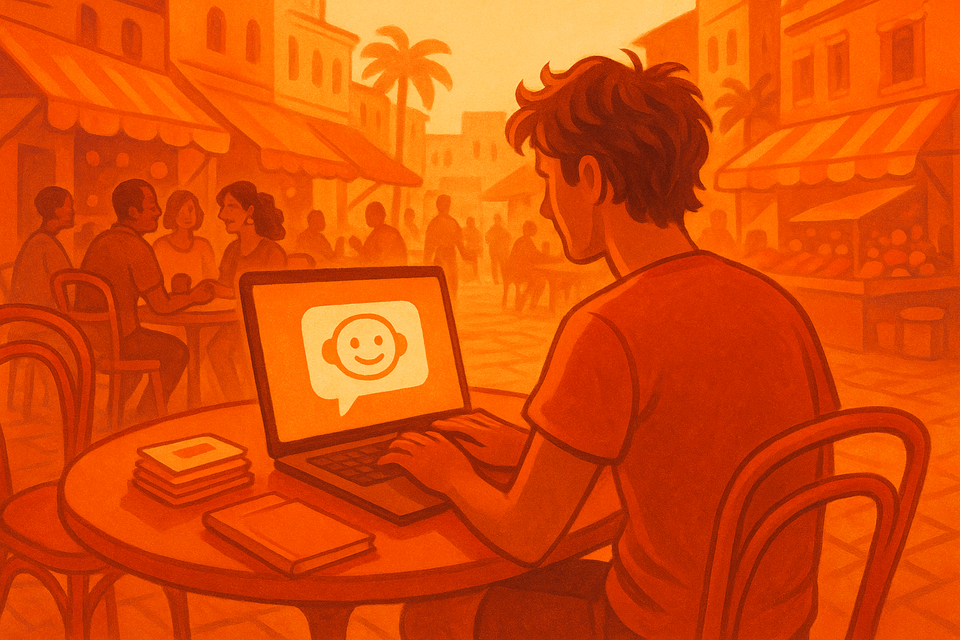
The AI Translation Crutch Every Digital Nomad Falls Into
You land in Lisbon, open Google Translate, point your phone at a menu, and feel like a genius. Three months later, you still can't order coffee without your phone. Sound familiar? AI translation tools have become the digital nomad's best friend and worst enemy simultaneously, and how you use them in 2026 makes the difference between someone who actually learns Portuguese and someone who just pretends to.
According to the 2025 MBO Partners Digital Nomads Report, AI assistants are increasingly helping digital nomads navigate language barriers. But there's a critical difference between using AI as a bridge to real language skills and using it as a wall that prevents you from ever developing them.
If you've been relying on translation apps as a permanent solution rather than a temporary scaffold, this guide will show you exactly how to flip the script — and actually become conversational in your host country's language while you're at it.
Why AI Translation Is Both Amazing and Dangerous for Nomads
Let's be real: AI translation in 2026 is genuinely impressive. Real-time conversation translation, camera-based text translation, and AI chatbots that can explain grammar on the fly have made it theoretically possible to live anywhere without learning a word of the local language.
And that's exactly the problem.
When the friction of not speaking a language disappears, so does the motivation to learn it. Every time you default to your phone instead of struggling through a conversation, you're robbing your brain of the very input and interaction it needs to acquire the language. Neuroscience research published in Frontiers in Psychology consistently shows that productive struggle — the uncomfortable process of trying to communicate with limited language — is one of the strongest drivers of language acquisition.
The digital nomads who actually become multilingual aren't the ones who avoid AI tools entirely. They're the ones who use them strategically, in ways that push past speaking anxiety rather than reinforcing it.
The 5 Rules for Using AI Translation Without Destroying Your Progress
Rule 1: The 30-Second Delay Rule
Before reaching for your phone, give yourself 30 seconds to try communicating with whatever language you have — gestures, the three words you know, pointing, drawing. This isn't about suffering; it's about giving your brain a chance to retrieve and produce language under real pressure.
That 30-second struggle is worth more than an hour of Duolingo. Your brain forms stronger neural connections when it has to work for the output. Only after you've genuinely tried should you reach for the translation app.
Rule 2: Use Translation for Preparation, Not Performance
The best way to use AI translation is before you need it, not during the conversation. Heading to the post office? Look up the key phrases you'll need before you go. Going to a restaurant? Review common food vocabulary and ordering phrases in advance.
This is the same principle behind the slow travel immersion method — you're setting yourself up for success by front-loading preparation so you can be present and engaged during actual interactions.
Rule 3: Translate TO Your Target Language, Not FROM It
Most nomads use translation apps to understand what locals are saying. Flip it. Use the app to figure out how to say what you want to say, then say it yourself — out loud, to a real person, without the phone visible.
This subtle shift turns translation from a comprehension crutch into a production tool. You're still getting help, but you're putting in the work of actually speaking, which activates completely different (and much more valuable) neural pathways.
Rule 4: Set "No Phone" Zones and Times
Designate specific situations where translation apps are off-limits:
- Morning coffee order: Learn it once, do it from memory every day
- Grocery shopping: Use context clues and ask shopkeepers in the local language
- Casual greetings: Hello, thank you, goodbye — no app needed
- Taxi/ride-share: Learn directions and common destination names
Start small and expand the zones as your confidence grows. The goal isn't to struggle through every interaction — it's to create pockets of genuine immersion in your daily routine.
Rule 5: Use AI to Debrief, Not to Cheat
After a conversation where you didn't understand something, then use AI. Ask ChatGPT or a similar tool: "Someone said [approximate sounds you remember] to me at the bakery — what might they have said?" Use it to fill in gaps after the fact rather than preventing them in real time.
This approach takes advantage of what cognitive scientists call the "generation effect" — when you try to retrieve or generate information before receiving the answer, you remember it far better than if you'd just been given the answer upfront.
The AI Tools That Actually Help Language Learning (Used Correctly)
Not all AI language tools are created equal. Here's how to use the major ones as a digital nomad without falling into the crutch trap:
Google Translate / DeepL
Best for: Preparing before interactions, understanding written documents (rental agreements, official forms), quick vocabulary lookups after conversations.
Danger zone: Real-time camera translation for menus, signs, and anything you encounter daily. If you're translating the same café menu for the third time, you've failed.
ChatGPT / Claude
Best for: Grammar explanations when you're confused, generating practice dialogues for specific situations, getting cultural context behind phrases, and debriefing after real conversations.
Danger zone: Using it as a real-time conversation intermediary. Have actual human conversations instead.
Speech-to-Text Translation
Best for: Emergency situations (medical, legal, safety). Absolutely use it when it matters.
Danger zone: Every other situation. The convenience is addictive and the learning cost is massive.
Building a Language Learning System Around Your Nomad Life
The real advantage digital nomads have over classroom learners is that you're already immersed. You don't need to simulate real-world practice — you just need to stop avoiding it. Here's a practical weekly system:
Daily Minimum (30 minutes total, scattered throughout the day)
- Morning: Order coffee and breakfast in the local language (5 min)
- Afternoon: Read one local news headline and try to understand it before translating (5 min)
- Evening: Have at least one genuine exchange with a local — shopkeeper, bartender, neighbor (10 min)
- Before bed: Journal three new words or phrases you encountered today (10 min)
Weekly Boost
- Attend a language exchange meetup — most nomad hubs have them
- Do one "adventure errand" entirely in the local language (bank, post office, hardware store)
- Watch one local TV show or YouTube channel without subtitles
Monthly Milestone
- Have a 15-minute conversation with a local on a topic beyond the basics
- Write a short message or email in the local language
- Navigate one completely new situation (doctor, mechanic, government office) without AI help
What Happens When You Stop Relying on Translation (Real Nomad Stories)
The shift from AI-dependent to AI-assisted usually happens around the 4-6 week mark if you follow the rules above. Here's what nomads typically report:
- Week 1-2: Uncomfortable. You stumble, make mistakes, and conversations take longer. You'll be tempted to go back to your phone constantly.
- Week 3-4: Key phrases become automatic. You stop translating common words in your head. Locals start responding to you differently — with more patience and genuine engagement.
- Week 5-8: You start overhearing and understanding fragments of conversations around you. Words you learned through real-world contexts like ordering street food stick far better than anything from an app.
- Month 3+: You're having real conversations. Not perfect, not eloquent, but real. And the experience of living in a country where you can actually communicate transforms from "extended vacation" to "genuine cultural immersion."
The Exception: When You Should Absolutely Use AI Translation
Don't be a hero in situations where miscommunication has real consequences:
- Medical emergencies — use every tool available
- Legal documents — rental contracts, visa paperwork, police interactions
- Safety situations — natural disasters, security threats, evacuation instructions
- Complex bureaucracy — taxes, banking regulations, visa requirements
The 2026 digital nomad visa landscape is more complex than ever, with many countries now requiring basic language proficiency for long-term residency. Using AI to navigate the paperwork while building real skills for daily life is the smart play.
The Bottom Line: AI Is a Ladder, Not a Hammock
The best digital nomads in 2026 aren't the ones who speak every language fluently, and they're not the ones who refuse to use technology. They're the ones who use AI translation as a ladder — something you climb and eventually don't need — rather than a hammock you sink into permanently.
Every interaction where you struggle through in the local language, even badly, is an investment. Every interaction where you default to your phone is a withdrawal. Over the course of a 3-month stay, those investments compound into something no app can give you: genuine connection with the place and people around you.
How do you balance AI tools with real language practice on the road? Have you caught yourself using translation as a crutch? Drop your experience below — the nomad community learns best from each other.