
How to Maintain Multiple Languages While Traveling
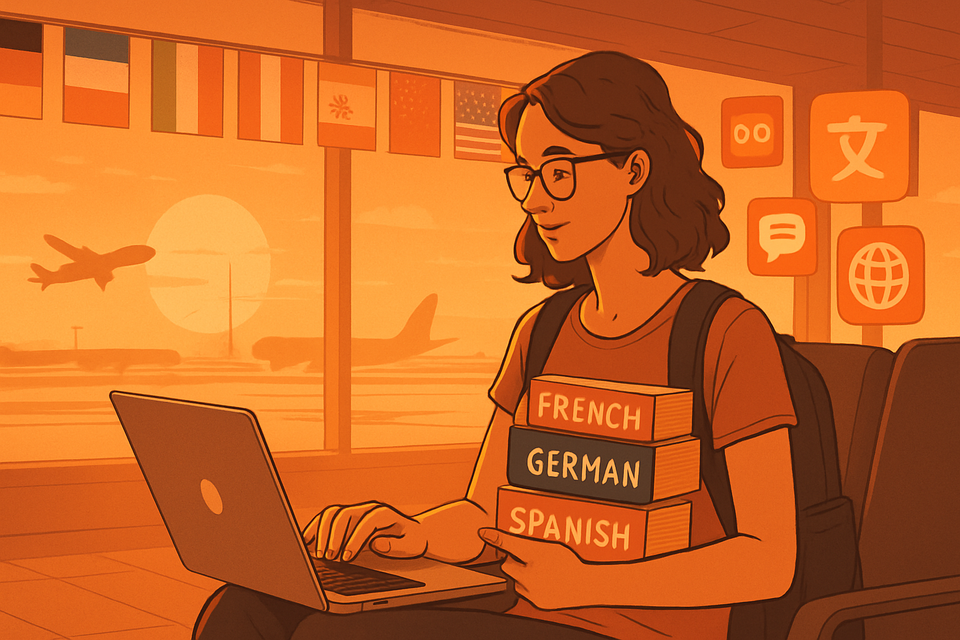
The polyglot nomad's eternal dilemma: you're in Mexico grinding your Spanish to conversational fluency, but your hard-won French is slowly evaporating. You start Portuguese for your upcoming Brazil trip, and suddenly both Spanish and French feel rusty.
Maintaining multiple languages while constantly changing locations isn't just challenging—it requires a completely different strategy than learning one language while staying in one place.
Here's the system I've developed over four years of nomadic polyglot life.
The Maintenance vs. Acquisition Mindset Shift
First, accept this reality: you cannot actively improve multiple languages simultaneously while traveling. What you can do is maintain some languages while focusing intensively on one.
This means clearly categorizing your languages at any given time:
- Active (1 language): The language you're immersed in or deliberately studying. This gets 80%+ of your language time.
- Maintenance (1-2 languages): Languages you want to keep sharp but aren't actively improving. These get consistent but minimal time.
- Hibernation (unlimited): Languages you'll revive later but aren't touching now. No guilt, no time allocation.
Trying to actively improve four languages while hopping between countries is a recipe for frustration and mediocrity in all of them. Research from Bilingualism: Language and Cognition confirms that focused attention produces better outcomes than divided effort.
The Minimum Effective Dose for Maintenance
For maintenance languages, you need enough exposure to prevent decay—not enough to improve. Surprisingly, this is quite minimal:
- Time: 15-20 minutes daily is usually sufficient
- Passive exposure counts: Podcasts, music, and videos in the background contribute to maintenance
- Spaced repetition: 50-100 Anki reviews keeps vocabulary from fading
The goal is keeping neural pathways active, not building new ones. Accept "good enough" for maintenance languages. Perfectionism here leads to neglecting your active language.
Building Language Practice Into Travel Days
Travel days—airports, flights, buses, waiting rooms—are perfect for maintenance languages. You're already in dead time; convert it to language time.
- Airport waiting: Anki reviews, podcast episodes (download offline first)
- Flights: Movies or shows in your maintenance language. Airlines often have foreign language content—check before booking.
- Long bus rides: Audiobooks, downloaded YouTube videos, music playlists with lyrics
- Random waiting: News articles, social media scrolling in target languages
Critical prep: Download everything the night before travel days. Decision-making while exhausted doesn't happen. Pre-loaded content is the only content that gets consumed.
The Geographic Trigger System
Instead of scheduling specific study times (which constantly shift with time zones and changing routines), I assign languages to activities:
- Morning coffee: French news podcast (RFI or France24)
- Workouts: Spanish music playlist
- Cooking: Italian YouTube in background
- Pre-sleep wind-down: Reading in Portuguese
These triggers travel with you. Coffee happens everywhere. Working out happens everywhere (or should). The habit persists across time zones and locations because it's attached to activities, not clock times.
The Language Rotation Strategy
Some polyglot nomads rotate their active focus monthly or by destination:
- Month 1 (Mexico): Spanish active, French maintenance, German hibernation
- Month 2 (France): French active, Spanish maintenance, German hibernation
- Month 3 (Berlin): German active, French maintenance, Spanish hibernation
This ensures each language gets intensive focus periods rather than constant diluted attention. Plan rotations around your travel calendar—active status should align with where you'll be living.
Using Each Location's Resources Strategically
Even when you're not focusing on a language, geographic location offers unique opportunities:
While in Spanish-speaking countries:
- Stock up on physical books (easier to find, much cheaper than imported)
- Download local podcasts and streaming content
- Note regional expressions and vocabulary for future study
- Get conversation practice that's impossible elsewhere
While in non-target-language countries:
- Find local speakers of your maintenance languages (French speakers exist everywhere)
- International meetup groups often have language exchange events
- Cultural centers (Alliance Française, Goethe Institut, Instituto Cervantes) exist in most major cities globally
- Focus on your active language without distraction
Tools That Make Multilingual Nomad Life Work
- Anki: Syncs across devices, works offline, handles multiple language decks cleanly. Essential.
- Language Reactor: Chrome extension for learning from Netflix and YouTube. Download content for offline use.
- Tandem/HelloTalk: Find language partners in any time zone. Async voice messages work across time differences.
- Spotify/Podcast apps: Pre-download content in each maintenance language. Organize by language for quick access.
- Kindle: Carry libraries in every language without weight. Built-in dictionary makes reading easier.
The digital nomad toolkit is actually perfect for language maintenance—if you set it up intentionally before you need it.
The Honesty Check: Accepting Attrition
Real talk: some languages will fade while you travel. That's okay.
I've let languages hibernate for years and revived them faster than expected. The foundation doesn't disappear—it just goes dormant. Research on language attrition and relearning shows that reactivation takes weeks or months, not the years it took to learn initially.
Give yourself permission to prioritize. A strong B2 in two languages beats a shaky A2 in five. For networking opportunities this creates, see our guide on networking in languages you don't speak fluently.
How do you balance multiple languages on the road? What systems have worked (or failed) for you? Share your strategies in the comments—we're all figuring this out together.