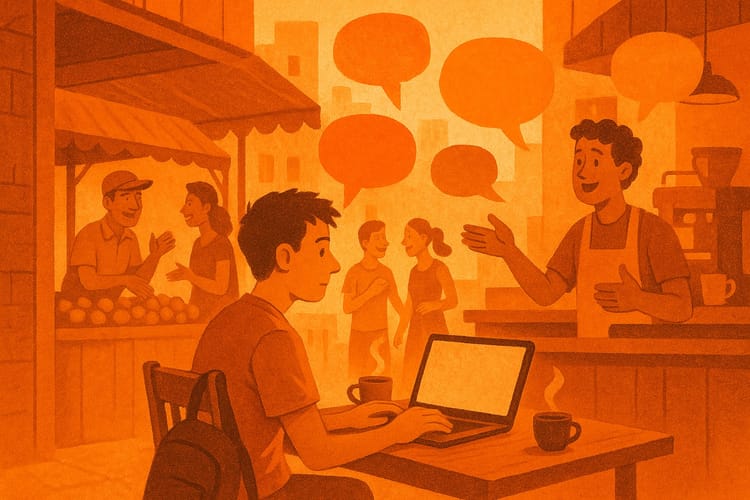
Digital Nomad Language Immersion Routine: The Neighborhood System That Makes Every Week Abroad Count
Digital nomad language immersion routine sounds sexy until you realize most nomads are living the same weird loop, apartment, laptop, delivery app, airport, repeat. You can move countries every month and still build a totally sterile life with almost no real language contact. If you want actual progress, you need a neighborhood system, not vague “immersion vibes.”
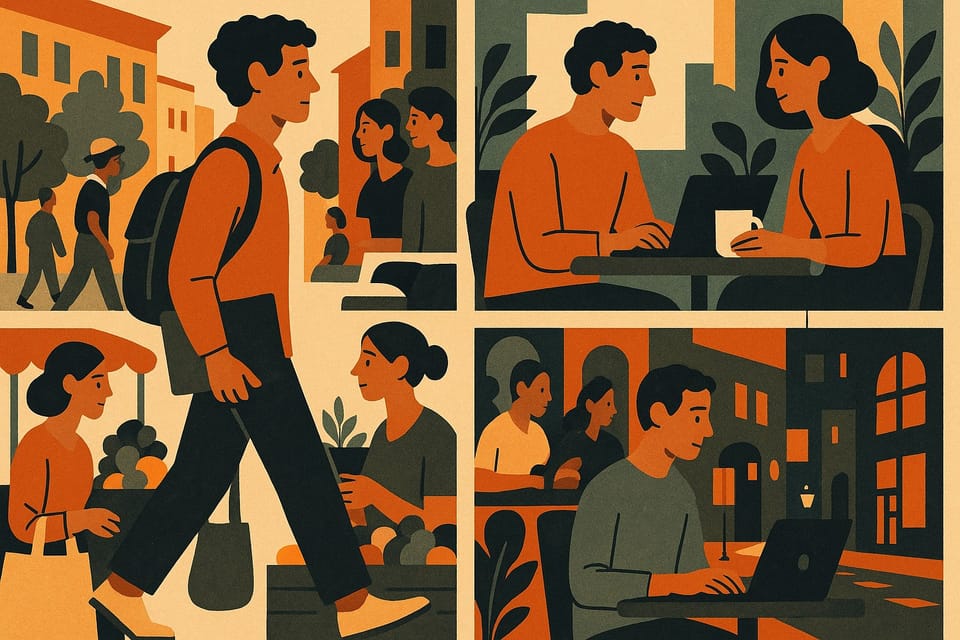
The strongest version of a digital nomad language immersion routine is built around repetition in public. Same café. Same market. Same gym. Same corner store. Same coworking desk cluster. Sociologists call these community anchors third places, and for nomads they matter because they create familiarity fast. That is also why our recent pieces on learning local slang without sounding like a clown, visa language requirements in 2026, learning Portuguese in coworking spaces, and choosing cities for Portuguese immersion all point back to the same truth, language grows where your life repeats.
Why most nomads fail at immersion even when they travel constantly
Travel is not the same thing as exposure. Exposure is not the same thing as interaction. Interaction is not the same thing as repeated social memory. You need all three. Most nomads get the first one, occasionally get the second, and completely miss the third.
- They stay in tourist-heavy neighborhoods where English does all the work.
- They keep changing routines before anyone remembers their face.
- They choose convenience over repetition, which kills familiarity.
- They treat language as an extra project instead of part of the day.
A real digital nomad language immersion routine fixes that by making daily life predictable enough for local relationships to form.
The neighborhood system, the backbone of a digital nomad language immersion routine
Pick one neighborhood and act like you live there, because for now you do. Not the whole city. One neighborhood. Learn the micro-geography. Where people buy bread. Where older locals sit in the afternoon. Which café has regulars instead of laptop zombies. Which gym staff actually chats. Which grocer tolerates your terrible grammar and still smiles.
Anchor 1, your morning place
This should be a café, bakery, or juice spot you visit almost every day. Order the same core thing for a week, then start varying one detail at a time. That gives you repetitive speaking reps with tiny changes. It is the most painless way to build transactional automaticity.
Anchor 2, your work-adjacent place
Coworking spaces are useful, but only if you stop treating them like silent airports. Ask staff about events. Sit near regulars. Show up for the same slot. If Portuguese is your target language, our guide to learning Portuguese in coworking spaces as a digital nomad is basically this strategy applied on purpose.
Anchor 3, your evening place
Gym, language meetup, street-food stall, bookstore café, dance studio, neighborhood bar, whatever gives you repeated low-pressure contact. Evening repetition is huge because people are less rushed and more willing to chat.
A weekly digital nomad language immersion routine that actually compounds
Monday, logistics day
- Map your anchors.
- Collect 15 high-frequency phrases you will need in that neighborhood.
- Do one walk with no headphones and just listen.
Tuesday, repeat and notice
- Return to the same morning and evening places.
- Notice the phrases locals repeat, greetings, filler words, payment questions, tiny jokes.
- Write down three phrases you hear more than once.
Wednesday, make one interaction longer
- Ask one extra follow-up question.
- Comment on something visible, weather, crowd, food, schedule, event.
- Stay for thirty seconds longer than you usually would.
Thursday, use the city as a classroom
- Go to the market instead of ordering in.
- Ask for recommendations instead of defaulting to Maps.
- Do one errand in the target language from start to finish.
Friday, social expansion
- Attend one recurring event, trivia, meetup, workshop, or local class.
- Introduce yourself with the same stable script every time.
- Ask others where they are from and what brought them there.
Weekend, consolidation
- Review the phrases that came up naturally.
- Walk the same blocks again and test them in real life.
- Plan next week around the places that generated the best conversations.
The three levels of immersion, stop confusing them
Level one is environmental immersion, signs, menus, overheard conversations, payment rituals. Level two is practical immersion, buying, asking, fixing, arranging. Level three is relational immersion, being recognized, remembered, and lightly expected. Level three is where things get good. Once people know your face, they speak to you differently, more naturally, more generously, less like customer service.
That is why third places matter. They are not just “nice atmosphere.” They are repetition engines. The public conversation around third places is mostly about community and loneliness, but for nomads there is a second payoff, they create predictable language loops you cannot get from random sightseeing.
How to choose the right city block, not just the right city
Nomads waste a lot of time debating countries when the more practical question is: will this block make me speak? A flashy city with a dead routine is worse than a less glamorous neighborhood with real recurring contact.
- Can you walk to groceries, coffee, and a work spot?
- Are there visible regulars, not just transient tourists?
- Do you hear the local language constantly?
- Can you afford to revisit the same places without resentment?
- Is there at least one evening social option nearby?
External resources worth using
Final take
The best digital nomad language immersion routine is not glamorous. It is repetitive on purpose. Same blocks, same faces, same little conversations until they stop being little. That is how a temporary stay starts feeling like a real life, and that is when your speaking ability finally stops resetting every month.
What is the one neighborhood in your current city that could become your language engine this week, if you stopped treating it like a backdrop and started using it like a system?