
5 Languages That Will Transform Your Digital Nomad Experience
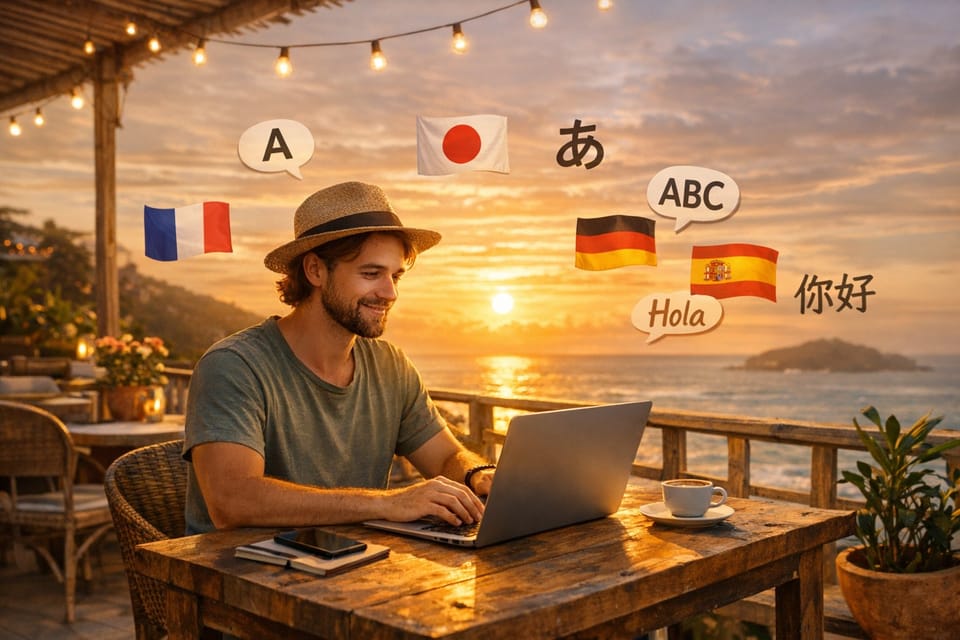
After four years of working remotely across three continents, I've learned something that travel blogs rarely mention: the language you speak determines the country you actually experience.
Sure, you can survive almost anywhere with English. Hostels, coworking spaces, tourist restaurants—they'll accommodate you. But there's a massive gap between surviving and thriving, between being a tourist with a laptop and actually becoming part of a community.
Here are five languages that have delivered the best return on investment for my nomadic lifestyle—and why they might transform yours.
1. Spanish — The Ultimate Nomad Language
Why it matters: Spanish unlocks over 20 countries across two continents, including some of the most desirable digital nomad destinations on the planet: Mexico, Colombia, Spain, Argentina, Costa Rica, and Peru.
The nomad advantage: Latin America offers unbeatable cost-of-living to quality-of-life ratios. According to Nomad List, cities like Mexico City, Medellín, and Buenos Aires consistently rank among the top destinations worldwide for remote workers—combining fast wifi, great coffee culture, vibrant social scenes, and affordable living.
English penetration: Lower than you'd expect outside tourist zones. In everyday situations—markets, local restaurants, neighborhood shops—Spanish is essential for real integration.
Difficulty for English speakers: Moderate. The Foreign Service Institute rates Spanish as a Category I language, requiring approximately 600 hours to reach professional proficiency. The pronunciation is straightforward, and you can reach conversational level in 6-8 months of dedicated practice.
Resources: Abundant. Language Transfer offers a free, excellent Spanish course. For nomad-specific vocabulary, check out SpanishPod101.
2. Portuguese — Your Brazilian Advantage
Why it matters: Brazil is one of the most underrated digital nomad destinations. It's enormous, culturally diverse, and once you're outside the major tourist zones, surprisingly affordable.
The nomad advantage: Florianópolis has been called "the island of magic" among nomads—combining stunning beaches, solid tech infrastructure, and a growing startup ecosystem. São Paulo offers world-class culture, food, and nightlife at developing-world prices. And Portugal itself provides EU access with a lower cost of living than Western Europe.
English penetration: Outside upscale areas of Rio and São Paulo, very low. Portuguese is genuinely necessary for daily life, which forces faster acquisition.
The Spanish connection: If you already speak Spanish, Portuguese becomes significantly easier. The languages share about 90% lexical similarity. You can reach basic conversational Portuguese in 2-3 months with a Spanish foundation.
European vs. Brazilian: They're mutually intelligible but noticeably different in pronunciation. Brazilian Portuguese is generally considered easier for beginners due to clearer vowel sounds. Decide based on where you plan to spend more time.
3. Thai — The Southeast Asia Gateway
Why it matters: Thailand has been the unofficial capital of digital nomadism for over a decade. Chiang Mai alone probably has more remote workers per capita than anywhere else on Earth.
The nomad advantage: Incredible infrastructure for remote work (fast, reliable wifi everywhere), extremely low cost of living, world-class food, and visa options that accommodate long stays. Thailand's Digital Nomad Visa now offers 5-year stays for qualifying remote workers.
English penetration: Moderate in tourist areas and nomad hotspots. But learning even basic Thai transforms your experience—suddenly you can negotiate at markets, chat with Grab drivers, and access the 90% of Thailand that most expats never see.
The challenge: Thai is tonal (5 tones) and uses a non-Latin script. It takes more initial effort than European languages. But the payoff is massive—Thais are incredibly appreciative of foreigners who make any effort to speak their language.
Strategic tip: For maintaining multiple languages while traveling, Thai makes a great complement to Spanish—completely different language family, keeps your brain engaged with variety.
4. German — The European Powerhouse
Why it matters: Germany has some of the most progressive freelancer visa policies in Europe. Berlin has been a tech and startup hub since before "digital nomad" was a phrase.
The nomad advantage: German also works in Austria, Switzerland (with premium salaries!), and parts of Eastern Europe. Germany's central location makes it easy to explore all of Europe by train. The startup ecosystem, especially in Berlin, offers networking opportunities unavailable elsewhere.
Career boost: German-speaking clients often pay premium rates and value long-term professional relationships. If you work in tech, engineering, design, or finance, German opens doors to high-paying contract work.
The challenge: German grammar is notoriously complex for English speakers (cases, gendered nouns, word order). The FSI rates it as Category II, requiring approximately 900 hours. But much of the vocabulary is recognizable to English speakers.
5. Indonesian — The Hidden Gem
Why it matters: Bali is already nomad-central, but Indonesia is so much more than one island. With over 17,000 islands and 270 million people, it's a country you could explore for a lifetime.
The nomad advantage: Extremely affordable living, incredible natural beauty, and improving digital infrastructure. The Indonesian government is actively courting remote workers with new visa programs.
Why Indonesian is underrated: It's surprisingly easy for English speakers. No tones, no gendered nouns, relatively simple grammar, Latin script. You can reach basic conversational level in just 2-3 months of dedicated study.
The secret weapon: Speaking Indonesian in Bali will absolutely blow people's minds. Most foreigners don't bother—they exist in English-speaking bubbles. Those who learn Indonesian get invited to ceremonies, family dinners, and parts of Balinese life that tourists never glimpse.
Bonus: Indonesian (Bahasa Indonesia) is almost identical to Malaysian (Bahasa Malaysia), effectively giving you two countries for one language effort.
How to Choose Your Next Language
Don't just pick based on perceived difficulty. Consider:
- Where do you actually want to spend time? There's no point grinding German if you hate cold weather.
- What's your work situation? Some languages open better career opportunities than others.
- Where's your existing community? Learning is dramatically easier when you have people to practice with.
- What's your timeline? If you're moving to Mexico in 3 months, Spanish takes priority over Mandarin.
The best language to learn is the one you'll actually use. Everything else is just theory. For a systematic approach to building any language into your nomad routine, check out our guide on maintaining languages while traveling.
Which languages have transformed your nomad experience? What destinations are you eyeing next? Share your picks in the comments—I'm always hunting for my next linguistic adventure.